The article below originally appeared in a comment I posted in Facebook under a link in the BBC page there to an article appearing in its own website here. I have expanded/modified my original Facebook comment somewhat.
The BBC has recently been forced to publish the salaries of all 'stars' being paid £150,000 p.a. or more, and this has confirmed what had only been strongly suspected before - wide differences between the remuneration paid to different people for doing what seem to be very similar work, with the differences being based on gender (men generally being paid more) and/or ethnic origin.
Gender inequality is wrong, so my suggestion is to lower all the salaries of the male so-called "stars" until they are similar to those of the females whose jobs are similar or indistinguishable from what they are employed to do. Some of the higher female salaries could be reduced too. If any of them (male or female) are not happy, they can I'm sure try to offer their talents instead to commercial networks in the hope of being paid more.
I imagine their contracts come up for renegotiation every few years - BBC management need to learn how to manage and husband its guaranteed revenue stream more wisely, via the mandatory licence fee it is privileged to receive. I rarely watch or listen to any of them (in the case of Chris Evans after his disastrous reboot of Top Gear), nor indeed many of those already on commercial networks also reputedly paid large sums, so it really will make zero difference to me.
Best of all, abolish the licence fee and replace it with subscriptions for those that wish to pay them, or take advertising. The BBC lost its way many years ago and while some aspects of it remain good, it does need a radical overhaul or outright replacement.

Showing posts with label UK. Show all posts
Showing posts with label UK. Show all posts
Monday, 24 July 2017
Thursday, 15 June 2017
On the resignation of Tim Farron as Leader of the Liberal Democrats
This is my brief "editorial" ['pretentious' - Ed.] on the resignation earlier this evening of Tim Farron as Leader of the Liberal Democrat Party:
If religion hadn't historically tried to impose its will on society, often by physical force and often by social pressure (very often even more powerful in controlling a gullible population), sceptics wouldn't be so fearful of the menace it has too often represented when it gains the upper hand.
Tim Farron [may feel he] has been harshly treated or at least "misunderstood", and to a certain limited extent even I, as a gay man, would tend to agree that he has, but one cannot divorce what has happened from the historical context of how religious dogmas have always behaved if they thought they could. It's not so long ago that one of the country's greatest heroes (Turing) was chemically castrated, because at that time merely being homosexual was a crime, largely based I would argue on the influence of the Christian religion in framing the country's laws then, and now another of these wacko religions (Islam, lest there be the merest scintilla of doubt to what I refer), because it can, is throwing gay men off of buildings, and consigning women to slavery.
To be clear, I don't think Tim Farron is any kind of danger as an individual, but the kind of thinking his beliefs represent, if they had the upper hand, petrifies me.
So Tim Farron has taken the, in my view, somewhat petulant decision to stand down from the Leadership of the Liberal Democrat Party and ended with the jibe that this is because the country is not truly 'democratic', nor 'liberal'. This is nonsense. The harsh reality is that a significant proportion of the population in many of what are self-described as "advanced societies" no longer 'believe in' nor are prepared to be dictated to by religion. If he had clearly said what his own personal views/beliefs are, when asked about it, but that this would not be used to influence his views on public policy, I think that would have defused the matter completely, indeed his own voting record in Parliament is pretty "respectable" in this regard. Instead however he repeatedly shied away from simply stating what his views are. So he has been somewhat harshly treated, but his own reaction to the pressures he has felt he has faced have been "sub-optimal", to put it mildly. And so he "exits stage left" from the political stage of party leadership.
NB/ I have deliberately avoided touching on his views on 'Brexit', by the way (about which he never stopped speaking); if he had been similarly open about his views on certain aspects of his religious beliefs, I do not think he would have landed up in this dilemma of his own making.
Friday, 9 June 2017
General Election 2017 - Results in Highland Council and Moray Council constituencies
This is a follow-on post from the 'candidates' article I wrote here on 12 May 2017.
For the constituency where I live, these are the results:
Inverness, Nairn, Badenoch and Strathspey
Boyd, Dr Donald MacLeod - 612 votes
Scottish Christian Party "Proclaiming Christ’s Lordship"
Cunningham, Ritchie - 6,477 votes
Scottish Liberal Democrats
Hendry, Drew - 21,042 votes (Elected)
Scottish National Party
Robb, Mike - 8,552 votes
Scottish Labour Party
Tulloch, Nicholas - 16,118 votes
Scottish Conservative and Unionist
- The sitting Scottish National Party MP, Drew Hendry, has been re-elected, but with a significantly reduced share of the vote (down 10.2% at 39.9%). The Conservatives have dramatically increased their vote, switching from 4th position in the 2015 election to take 2nd position from the Liberal Democrats, with 30.5% of the vote (up 24.6%), who themselves now occupy 4th position with a very significantly reduced vote (down 19% at 12.3%), whilst the Labour Party remains in 3rd position, although with a somewhat increased vote at 16.2% (up 8.7%), from a pretty low starting point.
For the other two Highland Council constituencies, the candidates are:
Caithness, Sutherland and Easter Ross
Bell, Olivia - 3,833
Scottish Labour Party
Mackie, Struan - 6,990 votes
Scottish Conservative and Unionist
Monaghan, Paul - 9,017 votes
Scottish National Party
Stone, Jamie - 11,061 votes (Elected)
Scottish Liberal Democrats
- this ia a Scottish Liberal Democrats gain from the Scottish National Party
Ross, Skye and Lochaber
Blackford, Ian - 15,480 votes (Elected)
Scottish National Party
Campbell, Ronnie the Crofter - 499 votes
Independent
Davis, Jean - 8,042 votes
Scottish Liberal Democrats
Mackenzie, Robert - 9,561
Scottish Conservative and Unionist
Ó Donnghaile, Peter - 4,695 votes
Scottish Labour Party
Sturrock, Stick - 177 votes
Something New
- The sitting Scottish National Party MP has been re-elected
For the Moray Council constituency, the candidates are:
Moray
Glen, Anne Betty - 204 votes
Independent
Kirby, Jo - 5,208 votes
Scottish Labour Party
Linklater, Alex - 1,078 votes
Scottish Liberal Democrats
Robertson, Angus - 18,478 votes
Scottish National Party
Ross, Douglas - 22,637 votes (Elected)
Scottish Conservative and Unionist
- this ia a Scottish Conservative and Unionist gain from the Scottish National Party
The source for all the results information here is in the BBC Election 2017 'micro-site' here - click on the 'Constituencies' link near the top of the page and from there you can find full results information for all constituencies - you can also scroll down any constituency page to find the results at the previous General Election in 2015.
Friday, 12 May 2017
General Election 2017 - Candidates in Highland Council and Moray Council constituencies
There is to be a General Election across the whole of the UK on 8th June 2017.
There are three parliamentary constituencies for Westminster elections (i.e. the UK Parliament) in the Highland Council area, and these are:
- Inverness, Nairn, Badenoch and Strathspey (INBS/INBandS);
- Caithness, Sutherland and Easter Ross (CSER/CSandER);
- Ross, Skye and Lochaber (RSL).
Because of the low population densities in most parts of the extremely large Highland Council area, the three parliamentary constituencies each cover quite large geographic areas too.
In addition and because of its proximity to the east of the Highland Council area, I have decided to cover the Moray Council area for this election, which has one parliamentary constituency for Westminster elections, namely Moray, nice and simple.
This article indicates no particular political preference for any candidate - it is intended to be purely factual and "neutral" and is published for my own reference over the coming weeks and in the hope it may be useful for others; because of the unexpected nature of this election, some relevant websites have not [yet] been updated to show important information, but one can expect the larger media outlets to "catch up" in coming days, meantime I have relied solely upon the official websites of the two council areas where the four constituencies I refer to here are located. In other articles I am likely to publish in coming days, my own political leanings, and recommendations for voting, will be made clear. Those who are familiar with my blog, or who happen to know me personally, will already know what my own views most probably are of course.
Because I live in the Inverness, Nairn, Badenoch and Strathspey constituency, I will cover it first and in a little more detail because, as well as listing the candidates, I include links to websites where available (or at least those I have identified so far), shown as national (UK), dedicated Scottish (SC), whilst some have a local Party website (LPW), and some candidates have their own personal websites:
Inverness, Nairn, Badenoch and Strathspey
Boyd, Dr Donald MacLeod
Scottish Christian Party "Proclaiming Christ’s Lordship" - UK - SC - his website
Cunningham, Ritchie
Scottish Liberal Democrats - UK - SC - LPW
Hendry, Drew
Scottish National Party - UK/SC - his SNP page
Robb, Mike
Scottish Labour Party - UK - SC - his Labour page
Tulloch, Nicholas
Scottish Conservative and Unionist - UK - SC - LPW
For the other two Highland Council constituencies, the candidates are:
Caithness, Sutherland and Easter Ross
Bell, Olivia
Scottish Labour Party
Mackie, Struan
Scottish Conservative and Unionist
Monaghan, Paul
Scottish National Party
Stone, Jamie
Scottish Liberal Democrats
Ross, Skye and Lochaber
Blackford, Ian
Scottish National Party
Campbell, Ronnie the Crofter
Independent
Davis, Jean
Scottish Liberal Democrats
Mackenzie, Robert
Scottish Conservative and Unionist
Ó Donnghaile, Peter
Scottish Labour Party
Sturrock, Stick
Something New
For the Moray Council constituency, the candidates are:
Moray
Glen, Anne Betty
Independent
Kirby, Jo
Scottish Labour Party
Linklater, Alex
Scottish Liberal Democrats
Robertson, Angus
Scottish National Party
Ross, Douglas
Scottish Conservative and Unionist
Sources used:
- The website of Highland Council is here and its election page can be viewed here, and all details are either in that page, or in linked pages from there.
- The website of Moray Council is here and its election page can be viewed here, and all details are in various linked pages from there, for candidates in the .pdf page here.
Friday, 5 May 2017
Local Government election - Highland Council - 4th May 2017 - results
( please see the ADDENDUM at the end)
Overall an excellent result for the Conservatives throughout Scotland and in my local government area - Highland Region - a pretty good result too, in fact an amazingly good outcome from a very low starting position for the party in Scotland.
In Scotland overall, though, let's not kid ourselves, the SNP retains the largest number of seats, albeit suffering a small loss in numbers of seats (-7). However, and pleasingly, it is Labour that has lost the most (-133), as have "Independent" (-26) and the Liberal Democrat (-3). Two groups have gained seats - Conservatives (+164) and Green (+5). The Conservatives have gone from 4th place to 2nd place in numbers of seats, overtaking both Labour, quite extraordinarily, and "Independent". You can see full results for Scotland here.
As for Highland Council, where I live, there are 74 seats in all, and the Conservatives have increased from a standing start of "zero", to take 10 seats, really very good indeed. You can see summary details with changes in the BBC website here.
In the Highland Council website you can see full summary seat holdings after all results have been declared, plus details for each Council Ward of which candidates have been elected - visit its website here.
In my own Council Ward (Ward 18 - Nairn and Cawdor), which has 4 of the 74 seats, the four councillors who have been elected are:
- FRASER, Laurie ("Independent")
- HEGGIE, Tom ("Independent")
- MACDONALD, Liz (Scottish National Party [SNP])
- SAGGERS, Peter (Scottish Conservative and Unionist)
With the remainder being unelected and eliminated:
- CUNNINGHAM, Ritchie (Scottish Liberal Democrats)
- FULLER, Stephen (Scottish National Party [SNP])
- GREEN, Michael ("Independent")
- MACKINTOSH, Andrew (Scottish Labour Party)
- MCINTOSH, Louis (Scottish Socialist Party)
- MCIVOR, Paul ("Independent")
More detailed voting information for Ward 18 - Nairn and Cawdor is available in the Highland Council website here, from which two .PDF files may be downloaded, yielding what to me is the extraordinary and pleasing result that, looking at 1st Preference Votes alone, the Conservative councillor Peter Saggers was second only to one of the Independent councillors Tom Heggie, both newly-elected at this election. The other two councillors elected were both re-elected, having been councillors in several previous councils. What is even more extraordinary, and pleasing to me, is that the re-elected SNP councillor Liz MacDonald in fact came 4th in 1st preference votes, whereas the other re-elected Independent councillor Laurie Fraser came 3rd in 1st preference votes. The two councillors who were not re-elected, but had been councillors upto now were Stephen Fuller and Michael Green.
Turning to the way in which the preference votes worked out in Ward 18, only one councillor was elected at Stage 1 and that is Tom Heggie who received 1,144 at this stage, because he exceeded the required quota of 1,061 votes. One councillor was elected at Stage 7, Liz MacDonald (647 1st pref votes). The remaining two elected councillors were elected at Stage 9, namely Peter Saggers (816 1st pref votes) and Laurie Fraser (694 1st pref votes). (Please also see the ADDENDUM at the end.)
Finally, for the parts of the UK which had local elections yesterday (much of England, all of Scotland and Wales), you can see full results here, but although all results have already been declared in England, Scotland and Wales, there are parts of England for which there are different procedures so are not incorporated into the linked BBC page because they now have Mayoral elections instead, and you can find those results here, however results in two Council Mayoral elections are shown separately in two separate pages - these are Doncaster (result here) and North Tyneside (result here). NB/ Please remember that there are parts of England where the election-cycle did not fall this time, as is the case with the whole of Northern Ireland.
ADDENDUM (Friday 5MAY2017 23.56 BST) I have now re-visited the Highland Council page already linked to above, but for the sake of convenience I repeat it here, where there is now another very interesting document in .PDF format to download, entitled "Candidate Votes Per Stage Report" which details how eligible votes evolved stage by stage until the quota of four elected councillors was arrived at. There is a further report also in .PDF format called "Transfers Report" which analyses in detail how this process evolved. Finally there is another report in 'raw' .CSV format called "Preference Profile Report Ward 18 Nairn and Cawdor" which provides further detail for those interested in a further level of analysis (if you haven't already thrown away your "Poll Card" you can see how your own votes were recorded in the system by checking against your own "Number on Register" by scrolling down the 4-digit reference in the left-most column of this .CSV report, although I suspect that the digits which follow have been further 'randomised' for added security, after re-examination of my own preference votes).
Monday, 1 May 2017
Alex Salmond and his silly letter to "The Scotsman" newspaper
I first became aware of this via a Facebook page I follow, but think it requires a mention here too, specially as we are only three days away from local government elections in Scotland, when we all have a chance to reduce the presence of the SNP, if not 'send them packing' entirely (my preferred option).
The Scotsman has now published Alex Salmond's letter in a separate "rebuttal" article and you can read what it says here.
You can also read the original article, written by Euan McColm to which Mr Salmond has taken exception, by clicking here. Nothing in Mr McColm's article is, in my opinion, any way intemperate, or "over the top", indeed I think it goes out of its way to present both sides of a very contentious debate.
Below I reprint my own comment, first published as my response to the brief posting I saw in the Facebook page I referred to above, which really only linked to Mr Salmond's letter, so that more people might see it:
* - Alex Salmond was a guest yesterday on BBC Sunday Politics, hosted by Andrew Neil, and you can view the whole interview below as someone has kindly uploaded it to YouTube:
The Scotsman has now published Alex Salmond's letter in a separate "rebuttal" article and you can read what it says here.
You can also read the original article, written by Euan McColm to which Mr Salmond has taken exception, by clicking here. Nothing in Mr McColm's article is, in my opinion, any way intemperate, or "over the top", indeed I think it goes out of its way to present both sides of a very contentious debate.
Below I reprint my own comment, first published as my response to the brief posting I saw in the Facebook page I referred to above, which really only linked to Mr Salmond's letter, so that more people might see it:
| Golly, his ego is so huge he can't take a bit of honest commentary! This is the guy who tried to bluff his way through an interview with Andrew Neil only this morning and Andrew wasn't taking any of his nonsense either (* - see at end). He is divisive, it's what a lot of people think, amongst which I'm happy to count myself. I am totally cheesed of with this narcissist. He tried to imply in his silly letter that the criticism of him by McColm was merely as a proxy for covert commentary on Sturgeon, but in my opinion he deserves plenty of obloquy directed at him personally, both for his performance as First Minister, and perhaps even more so since he stepped down and has behaved in increasingly quixotic and erratic ways. Obviously I can't see into the author's mind, but in my opinion there's plenty of justified criticism to share between both Salmond and Sturgeon and the rest of the SNP 'cult' in government, including the completely useless John Swinney and Humza Youssef, and they're just the names that immediately pop into my head, because there are many more incompetents in that crowd of shysters to choose from for a tongue-lashing. Finally, whilst the SNP have successfully stifled dissent amongst their own members, officials, elected people and supporters, Scotland is not yet a "one party state" and until they are mad enough to try and make dissent illegal, people like me will not hesitate to call these obsessives out on their many and varied deficiencies, not least for the incompetent way they have run the Scottish Government since they managed to bamboozle the Scottish elecotrate into voting them into power. Golly, how I loathe these people! |
* - Alex Salmond was a guest yesterday on BBC Sunday Politics, hosted by Andrew Neil, and you can view the whole interview below as someone has kindly uploaded it to YouTube:
Keep Scotland British! You know it makes sense!
If you're in Scotland vote "Anyone but SNP" in the 4th May and 8th June elections
If you're in Scotland vote "Anyone but SNP" in the 4th May and 8th June elections

Thursday, 27 April 2017
A week today vote "Anyone but SNP" in the 4th May Scottish Local Government Elections
Just a wee reminder:
When voting in the Local Government Elections on Thursday 4th May 2017, if you are in Scotland, please use your voting choices by voting for "Anyone but SNP", whilst avoiding voting for the Greens, or any "Independent" council candidate who has a record of supporting the SNP/Green "Scottish separation/indpendence" agenda, preferably using at least one of your preference votes (as high up in your list of preferences as possible), by voting Conservative .
Wherever else you are in the UK (if not in Scotland), I similarly urge you to vote Conservative in next week's Local Government Elections too.
After the final push for next week's Local Government Elections, we voters have a few weeks of respite before returning to the voting booths again on Thursday 8th June to vote in the General Election, when it is doubly important, for those of us in Scotland, to reduce the representation of the SNP at Westminster as much as possible, either by voting for the political party you favour personally (Conservatives in my case, or Labour, LibDems or even, at a pinch, UKIP), or by voting "tactically" for another political party which seems likely to do well in your own constituency - all to maximise the chances of defeating and ejecting sitting SNP MPs. The Spectator magazine has a useful article here to assist you in how best to deploy your "tactical vote" in Scottish constituencies for the Westminster election on 8th June to have the maximum anti-SNP value. The Scottish Greens are allied with the SNP in aiming to split the UK asunder too, so wherever you are please don't vote for them either.
If you are elsewhere in the UK, in England or Wales, I urge you to vote vote Conservative, to unseat as many Labour and LibDem sitting MPs as possible; in Northern Ireland please show your support by voting for a political party which supports the UK.
Keep Scotland British!
Help to re-elect a Conservative Government!
You know it makes sense!
Help to re-elect a Conservative Government!
You know it makes sense!
Friday, 21 April 2017
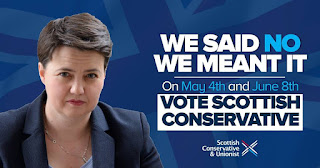
In the General Election on 8th June - vote Conservative
Just five weeks after the upcoming Local Government elections on 4th May, we will be having a General Election in the UK on 8th June.
Do you want the sensible, rational policies offered by the Conservatives, or do you favour a shambolic government by a very left-wing and dysfunctional 'socialist' Labour Party, either alone or in coalition with its fellow-travellers on the left, the SNP and the LibDems?
The choice is very clear:

Do you want the sensible, rational policies offered by the Conservatives, or do you favour a shambolic government by a very left-wing and dysfunctional 'socialist' Labour Party, either alone or in coalition with its fellow-travellers on the left, the SNP and the LibDems?
The choice is very clear:
Vote Conservative! You know it makes sense!

Thursday, 20 April 2017
If you're in Scotland vote "Anyone but SNP" in the 4th May and 8th June elections
Local Government Elections are being held throughout the UK (except NI) on 4th May and a General Election is being called for 8th June throughout the whole of the UK.
Wherever you are in the UK, I urge you to vote Conservative in the General Election and if you are in Scotland, when voting in the Local Government Elections please use your voting choices by voting for "Anyone but SNP", whilst avoiding voting for the Greens, or any "Independent" council candidate who has a record of supporting the SNP/Green "Scottish separation/indpendence" agenda.
Wherever you are in the UK, I urge you to vote Conservative in the General Election and if you are in Scotland, when voting in the Local Government Elections please use your voting choices by voting for "Anyone but SNP", whilst avoiding voting for the Greens, or any "Independent" council candidate who has a record of supporting the SNP/Green "Scottish separation/indpendence" agenda.
Keep Scotland British! You know it makes sense!
Saturday, 4 February 2017
"Theresa May wins Spain’s support over early deal for rights of expat Brits in Europe"
The title of this article, in quotations, is taken from an article published in the Daily Express newspaper yesterday evening - you can read it here.
I've no idea whether this Daily Express article is authoritative or speculative - it would be helpful to see a similar message in other parts of the mainstream media, not to mention direct quotes from both Mrs May for the UK and Sr Rajoy for Spain in particular, although the article does contain a number of direct statements attributed to a spokesman for Mrs May:
On this basis, these are my remarks on what may have been achieved, but what obviously still requires to be formalised:
This sounds hopeful but I'd be cautious about over-optimism until formal agreement is reached - both the UK and Spain have an interest in resolving this issue quickly, but if Germany and some others remain intransigent, it may not happen so smoothly as this implies - my view is and has always been that the rights of existing EU27 residents in the UK must be protected; it is not the British government that is holding cross-border EU residents to ransom, despite attempts in some parts of the British media to paint this picture, it is countries like Germany.
There should be no illusions about this - Brussels regards Britons in the rest of the EU and residents in the UK from the rest of the EU as bargaining chips in their plans to make the UK's exit (aka 'escape') from the clutches of the EU as painful as possible - the Eurozone is in such a mess that Brussels will go to almost any lengths to keep its banks afloat (notably Deutsche and certain of the French banks, which are heavily exposed in places like Spain, Italy and of course Greece, etc).
Personally I have few qualms about Merkel's 'crazy' immigration policy, because luckily the UK is not a member of the Schengen area, something which is only possible because the UK happens to be comprised of islands off the mainland of Europe (Ireland is also outside of the the Schengen area, it being a practical solution because of its long-standing relations with the UK, but is really for Ireland's convenience, especially given the open border between Ireland and Northern Ireland dating back to, from memory, 1923 - long before either country joined the EEC (now EU).
It is no accident that thousands of prospective immigrants surged through Schengen in to Germany, Finland, amongst other destinations, and to Calais (hoping to smuggle themselves into the UK, until the French government at last took the situation in hand and dispersed them around the country). It is possible that a proportion of the large number of 'immigrants' referred to are genuine 'asylum seekers' to whom refuge must be granted, but it seems to be generally agreed that these represent at most 50% of the total numbers and perhaps considerably less. Although the rules for claiming 'asylum' are that a claim must be lodged in the first 'country of sanctuary' (often Greece or Italy within the EU, but also countries such as Turkey and Lebanon), it has always seemed to me only fair that all EU members should share the burden, certainly financially if not always physically - it is striking that the UK contributes more than the rest of the EU combined to this effort and is second only to the US in this financial assistance. Those 'first sanctuary' countries, all of them, have in my view tried their best to accommodate as many genuine refugees as they can, given their own high levels of unemployment and the fact that their economies are generally much less robust than some of the countries further north in the EU (Austria, Germany, Holland, Finland and of course the UK) and from what I can gather the two of them in the EU (Greece and Italy) had been pleading for help from the rest of the EU, both financial and practical, for some years, but had largely been ignored and left to get on with it as best they could, until the surge of numbers in the summer of 2015 shamed the EU and in particular Germany to accept as many as could travel there - the open Schengen border then (since restricted somewhat in practical terms) made transit across the continent fairly easy, if chaotic - but the drawback was that the huge numbers meant that any real effort to distinguish between 'immigrants' ('economic' or other) and genuine 'asylum seekers' became almost impossible, not aided by the fact that many discarded whatever ID they may have had, or obtained forged documentation from what were considered to be more acceptable 'asylum' countries, such as Syria or Iraq and a few others such as Sudan or South Sudan etc, when many of those concerned probably came from completely different countries, whilch although poor were not in a state of political turmoil requiring 'asylum'. This article is NOT about immigration or asylum, however, but it is impossible not to mention this topic when discussing wider matters relating to EU membership and the rights and responsibilities that status implies.
The UK will always need "immigrants" and generally welcomes them, as we have a robust economy and relatively low unemployment. We also have a long history of accepting refugees in need of asylum and I hope this will continue long into the future, quite apart from our international obligations in this regard. It seems to me that although relatively few genuine asylum seekers arrive direct in the UK from the countries they are fleeing from, even if through equally dangerous countries, that we have to play our part in helping, at the very least financially, those countries where genuine asylum seekers are likely arrive first in Europe. It is certainly unfair to leave it all to Italy and Greece within the EU, or Turkey, Jordan and Lebanon, which already have accommodated large numbers of refugees - and are not wealthy countries themselves - simply because geography places them in the path of these genuine refugees.
Coming back to the main topic of this article, however, I do hope the governments of the EU27 overall (and not just Spain, obviously one of the more important member states) will come to their senses and agree quickly measures to protect both EU27 citizens in the UK and UK citizens in the EU27 - the UK government and now apparently Spain want to get this matter resolved quickly. Let's hope sense will prevail in Brussels (& Germany) so that this agreement can de done quickly. Although I didn't agree with 'remainer' Theresa May's seeming intransigence, I have come to the conclusion her robust, but fair, attitude has been the better course to follow and will in due course stand the best chance of allowing this matter to be resolved in a common sense way. But it needs reciprocal good will from the EU27 too - given that, I do not think the UK will be found wanting. But we have taken the decision to depart the EU and the stamping of feet in frustration and anger by anyone is highly unlikely to change this and given the British nature is only likely to harden attitudes here, which frankly is the last thing I wish to see happen.
(NB/ This article is also cross-posted to my "Spanish" blog casabill - the blog [link] - see also link to relevant article).
I've no idea whether this Daily Express article is authoritative or speculative - it would be helpful to see a similar message in other parts of the mainstream media, not to mention direct quotes from both Mrs May for the UK and Sr Rajoy for Spain in particular, although the article does contain a number of direct statements attributed to a spokesman for Mrs May:
Comments directly attributed to a spokesman for Mrs Theresa May, British Prime Minister: "They both agreed it was an area it would be good to get agreement early on in the negotiations. "He said we need to get an agreement on reciprocal rights. "We are firmly of the opinion that we want this issue that is resolved early. There is some broad agreement across member states but not all of them. "They both agreed it would be an area it would be good to get an early agreement on." |
This sounds hopeful but I'd be cautious about over-optimism until formal agreement is reached - both the UK and Spain have an interest in resolving this issue quickly, but if Germany and some others remain intransigent, it may not happen so smoothly as this implies - my view is and has always been that the rights of existing EU27 residents in the UK must be protected; it is not the British government that is holding cross-border EU residents to ransom, despite attempts in some parts of the British media to paint this picture, it is countries like Germany.
There should be no illusions about this - Brussels regards Britons in the rest of the EU and residents in the UK from the rest of the EU as bargaining chips in their plans to make the UK's exit (aka 'escape') from the clutches of the EU as painful as possible - the Eurozone is in such a mess that Brussels will go to almost any lengths to keep its banks afloat (notably Deutsche and certain of the French banks, which are heavily exposed in places like Spain, Italy and of course Greece, etc).
Personally I have few qualms about Merkel's 'crazy' immigration policy, because luckily the UK is not a member of the Schengen area, something which is only possible because the UK happens to be comprised of islands off the mainland of Europe (Ireland is also outside of the the Schengen area, it being a practical solution because of its long-standing relations with the UK, but is really for Ireland's convenience, especially given the open border between Ireland and Northern Ireland dating back to, from memory, 1923 - long before either country joined the EEC (now EU).
It is no accident that thousands of prospective immigrants surged through Schengen in to Germany, Finland, amongst other destinations, and to Calais (hoping to smuggle themselves into the UK, until the French government at last took the situation in hand and dispersed them around the country). It is possible that a proportion of the large number of 'immigrants' referred to are genuine 'asylum seekers' to whom refuge must be granted, but it seems to be generally agreed that these represent at most 50% of the total numbers and perhaps considerably less. Although the rules for claiming 'asylum' are that a claim must be lodged in the first 'country of sanctuary' (often Greece or Italy within the EU, but also countries such as Turkey and Lebanon), it has always seemed to me only fair that all EU members should share the burden, certainly financially if not always physically - it is striking that the UK contributes more than the rest of the EU combined to this effort and is second only to the US in this financial assistance. Those 'first sanctuary' countries, all of them, have in my view tried their best to accommodate as many genuine refugees as they can, given their own high levels of unemployment and the fact that their economies are generally much less robust than some of the countries further north in the EU (Austria, Germany, Holland, Finland and of course the UK) and from what I can gather the two of them in the EU (Greece and Italy) had been pleading for help from the rest of the EU, both financial and practical, for some years, but had largely been ignored and left to get on with it as best they could, until the surge of numbers in the summer of 2015 shamed the EU and in particular Germany to accept as many as could travel there - the open Schengen border then (since restricted somewhat in practical terms) made transit across the continent fairly easy, if chaotic - but the drawback was that the huge numbers meant that any real effort to distinguish between 'immigrants' ('economic' or other) and genuine 'asylum seekers' became almost impossible, not aided by the fact that many discarded whatever ID they may have had, or obtained forged documentation from what were considered to be more acceptable 'asylum' countries, such as Syria or Iraq and a few others such as Sudan or South Sudan etc, when many of those concerned probably came from completely different countries, whilch although poor were not in a state of political turmoil requiring 'asylum'. This article is NOT about immigration or asylum, however, but it is impossible not to mention this topic when discussing wider matters relating to EU membership and the rights and responsibilities that status implies.
The UK will always need "immigrants" and generally welcomes them, as we have a robust economy and relatively low unemployment. We also have a long history of accepting refugees in need of asylum and I hope this will continue long into the future, quite apart from our international obligations in this regard. It seems to me that although relatively few genuine asylum seekers arrive direct in the UK from the countries they are fleeing from, even if through equally dangerous countries, that we have to play our part in helping, at the very least financially, those countries where genuine asylum seekers are likely arrive first in Europe. It is certainly unfair to leave it all to Italy and Greece within the EU, or Turkey, Jordan and Lebanon, which already have accommodated large numbers of refugees - and are not wealthy countries themselves - simply because geography places them in the path of these genuine refugees.
Coming back to the main topic of this article, however, I do hope the governments of the EU27 overall (and not just Spain, obviously one of the more important member states) will come to their senses and agree quickly measures to protect both EU27 citizens in the UK and UK citizens in the EU27 - the UK government and now apparently Spain want to get this matter resolved quickly. Let's hope sense will prevail in Brussels (& Germany) so that this agreement can de done quickly. Although I didn't agree with 'remainer' Theresa May's seeming intransigence, I have come to the conclusion her robust, but fair, attitude has been the better course to follow and will in due course stand the best chance of allowing this matter to be resolved in a common sense way. But it needs reciprocal good will from the EU27 too - given that, I do not think the UK will be found wanting. But we have taken the decision to depart the EU and the stamping of feet in frustration and anger by anyone is highly unlikely to change this and given the British nature is only likely to harden attitudes here, which frankly is the last thing I wish to see happen.
(NB/ This article is also cross-posted to my "Spanish" blog casabill - the blog [link] - see also link to relevant article).
Friday, 20 January 2017
Recent developments in 'Brexit' - the planned departure of the UK from the EU
Apart from the 'minor event' [irony alert] across the Atlantic today, with the inauguration of a new President (the 45th, President Trump) in the United States of America, there have been some major developments here too, in relation to the United Kingdom (UK) and its forthcoming exit from the European Union (EU), in the past few months. In October 2016 the Prime Minister Mrs May announced that she would 'trigger' Article 50 of the Lisbon Treaty no later than 31st March 2017 - you can read more about this here. Much more recently, on 17th January 2017 she delivered a major speech in which she set out 12 key areas in her plans for implementing our departure, one of which specially pleases me, that we will no longer be a part of the 'Single Market' (aka the 'protectionist cartel' of the EU) - you can read more about this here and here.
The 12 key areas referred to above include:
- 1. Certainty;
- 2. Control of our own laws;
- 3. Strengthen the union (referring to the four nations which together comprise the UK);
- 4. Maintain the Common Travel Area with Ireland;
- 5. Control of immigration;
- 6. Rights for EU nationals in Britain, and British nationals in the EU;
- 7. Protect workers' rights;
- 8. Free trade with European markets;
- 9. New trade agreements with other countries;
- 10. The best place for science and innovation;
- 11. Co-operation in the fight against crime and terrorism;
- 12. A smooth, orderly Brexit.).
Naturally there has been considerable reaction to her speeches, not only within the UK itself (and of course from our 'illustrious' [another irony alert] First Minister in Scotland), but perhaps more relevantly from some leading figures within the EU itself; I don't plan to detail that here, except to observe that most of the 'spluttering' responses from EU functionaries and leaders from other countries has been uniformly negative and frankly intransigent. Perhaps not entirely unexpected, but given the shambles which the EU has got itself into, with its badly thought out policies, is still somewhat remarkable, when subjected to critical analysis. Specially of course the Eurozone of the 'single currency', the Euro, but the general protectionist reality of what is purported to be a 'free market' (aka the 'single market'), but of course is nothing of the kind - it is basically a protectionist cartel, specially in anything relating to food, for the benefit of a few members, but certainly not of the UK.
The high unemployment levels, in particular amongst younger citizens, in certain member-states of the EU, mainly amongst southern countries, appears not to concern the Brussels bureaucracy or the leaders of the few Eurozone member countries which benefit directly from the monetary union represented by the Euro. I find this particularly reprehensible. This is indeed probably the major reason that changed me from being a fervent Europhile to someone convinced we as a country had to get oursleves out of this bizarre mess, which is anything but 'democratic'.
Sunday, 30 October 2016
John Gordon Macintyre, Nairn - Obituary
5 October 1931 - 25 September 2016  Rest in Peace |
Always known as "J Gordon Macintyre", Gordon Macintyre was a flamboyant and eccentric, but hugely likeable fixture of Nairn (and beyond in certain circles) for many decades. I first met Gordon soon after I came to live in Nairn in September 2000, as I was invited by one of my new neighbours to join her as a guest at a chamber music concert at Clifton House, which it so happens is just around the corner from where I now live, and immediately joined the Nairn Performing Arts Guild (NPAG), a registered charity run by him and which organised chamber music recitals, plays and readings of various kinds. I remained a member until NPAG was succeeded by Music Nairn, when Gordon and his wife, Muriel, decided to move from their long-term home and business at Clifton House (run for many years as a quirky and wonderful small hotel and restaurant, until a few years before they moved), as they now wished to 'retire', to a new home just outside Nairn at Geddes.
From the word go I seemed to 'click' with Gordon - I liked him a lot and I think that feeling was reciprocated. He was an unusual and rather eccentric man, specially when compared with his rather more down-to-earth, fiercely intelligent and occasionally 'waspish' wife Muriel. But Gordon was of course in his own way a practical businessman too, running their hotel and restaurant business very successfuly in his own inimitable and flamboyant way. Muriel sadly passed away some years ago, in June 2009. Gordon was always immaculately and often colourfully attired, often sporting one of his extensive collection of bow-ties or cravates; even in his later declining years, though his attention to the detail of his wardrobe perhaps had slipped a little, he still managed to look smart and certainly always stood out from the crowd in whichever gathering he found himself. I count myself fortunate to have known Gordon, albeit only in the later stages of his life - it made settling in to my new home in Nairn so much more pleasurable.
It so happens I was away at my holiday home in Spain for a month from toward the end of September, as it turns out just a few days after his demise, which I had not heard about when I left for Spain. However, he had telephoned me about a week prior to this (I think therefore only three or four days before before his death) to ask me to postpone a visit to his home that we had been talking about, as he was feeling 'off-colour', saying that he would contact me when he was feeling a bit better. In the light of his death so soon after the call, I now think he was probably telephoning, consciously or unconsciously, to say 'goodbye'. It so happens his obituary was in our local weekly newspaper, The Nairnshire Telegraph (no online presence) only this week, in the issue dated Tuesday 25th October, a month after his death, whereas his obituary in The Scotsman was published only a few days before that on 20th October (read it here), to which it bears a certain similarity, so it is possible his family had deliberately kept his death low-key for the first month, it being inconceivable to me that it would not have been written about sooner, specially in our local newspaper, otherwise.
In any case, I am very saddened to learn of Gordon's death. I am just grateful that I had the pleasure of knowing him and for his friendship.
Saturday, 3 September 2016
Further thoughts on the EU, "Brexit" and related matters
As we are now at the beginning of September, and the end of the main summer holiday period when many politicians, civil servants and citizens generally will have been on holiday, it is I think now appropriate to write the kind of article I am now writing. As has often been the case in earlier years the month of August has, apart from being an hiatus in 'business as usual' for politics, also been a time when eccentric stories become newsworthy for broadcasters searching for things to write about during the dog days of summer.
For most, probably all, of my adult life I have been strongly supportive of the EEC (later the EU) and of the UK joining it and remaining a part of it. Personal circumstances meant I was not able to vote in the 1975 referendum, two years after the UK joined the EEC, to decide whether the country should remain or leave - I lived then in a place called Djibouti (wedged between Ethiopia/Eritrea and Somalia) in the north-east of Africa, and at that time people living outside the UK could not vote in UK elections, except in very special circumstances. But had I been in a position to vote, I would certainly have voted to remain in the EEC.
Broadly speaking, with perhaps just a few qualms, I supported most of what was done later, where it affected the UK. The Schengen Treaty (from 1985 to 1995 until 1997 when it was incorporated into EU law by the Amsterdam Treaty), did not and does not affect the UK, or as it so happens Ireland (that last bit is really irrelevant to me, of course, because even though it might otherwise affect Northern Ireland, there has been a common travel area between the UK and Ireland for a long time, unaffected by the independence of Ireland from the UK). The fact that the UK is an island nation meant, in my view, that it was practical, if not in the view of some I suppose entirely desirable, not to adopt Schengen. I doubt if it would have been easily do-able if we had land borders other than with Ireland. It is probably no accident either that our decision to remain outside Schengen coincided with plans to build the Channel Tunnel link between the UK and France (constructed between 1988 and 1994) - the value of that decision has perhaps only become more sharply defined by the events of very recent years.
The Single European Act, whose main purpose was to enhance 'free trade', ultimately came into force in 1987, having been delayed in its implementation by actions in Denmark, Greece, Italy and Ireland. Interestingly, it is probably the only piece of EU legislation largely championed from inception to conclusion by the UK. Because the UK has, for decades and indeed centuries, been all about 'free trade'. It did extend QMV ('Qualified Majority Voting') though, as part of the price paid [by the UK] for certain other countries (basically France and a few others) to allow this legislation to pass. The subsequent Treates (Maastricht, Amsterdam and Nice), whilst ratcheting the EU's control a little tighter with each step, seemed to me 'acceptable' in the greater scheme of things.
What really began to make me rethink my view of the fundamental wisdom of the UK being a member of the EU were the referendums on the now-defunct European Constitution held in 2005 in both the Netherlands and France, in which both rejected its proposals (others had already had referendums to ratify it), which effectively halted that particular process, and specifically what followed a few years later; the UK government had earlier promised a referendum, but the rejections by others made that pointless. Having read the draft European Constitution in great detail myself, in anticipation of a referendum being held in the UK, I too would have voted against it had I had the opportunity.
What followed a few years later was the Lisbon Treaty, effectively the European Constitution rewritten, pushed through in spite of being initially rejected in a referendum in Ireland in 2007, later shoved through in that country in 2009 in the face of the economic crisis facing that country after the 'crash' of 2007/2008; but let's face it, no one really cares what Ireland thinks (certainly not most of the other members of the EU, other than the UK), so they were 'prevailed upon' to allow it to pass. The reality is that the UK independently bailed out Ireland during this crucial period, not because of any undue sentimentality (that is not the British way), but simply in a recognition of the historic intertwining links between the British and much smaller Irish economies, although perhaps influenced also by the social and familial links between the two countries. The harsh reality, though, is that without UK support, Ireland would have been 'sunk', as otherwise Ireland would have been consigned to the same 'hell'/purgatory currently occupied by Greece. As for the semi-clandestine ratification by the UK of that Treaty by our then Prime Minister, Gordon Brown, I would prefer to remain silent; the level of contempt I have for that man is infinite and only a modicum of concern about the libel laws of this country will restrain me from writing what I really think about that excuse for a man; as I am also Scottish (and 1/4 quarter Irish as it so happens, with reference to earlier comments) I don't think accusations of 'racism' apply, although I am quite happy to acknowledge that it is my firm belief that the "socialism" that Gordon Brown and those who think like him profess to believe in, is one of the greatest evils that existed when I was born and unfortunately continues, luckily in much reduced form, to this day, I have grown weary of glossing over this basic reality in recent years, so this is the first time, apart from brief allusions to it in Twitter from time to time, that I have really 'let rip' on this issue. Unfortunately there is not a great deal to choose between the destructive effects of the "socialism" offered by Labour ('new', and the 'old' back-to-the-future kind which current leader Corbyn represents) and that offered by the SNP.
On Friday 2nd September our sad excuse for a First Minister in Scotland, Ms Nicola Sturgeon, gave up on her 'day job' of actually running Scotland in accordance with the Scotland Act (as amended), in favour of a pointless resurrection of the obsessive and obsessed SNP policy of wanting to rip Scotland out of the UK, despite very recent opinion polls demonstrating that the people of Scotland, apart from adherents of the 'SNP cult' which Ms Sturgeon leads, have little or no desire for this to happen, and far less desire for the holding of another referendum to try and change the result of the referendum held on the matter as recently as September 2014.
Despite the febrile predictions of those who campaigned vociferously for the UK to remain a member of the EU, the economy continues to be robust and the exchange rate of our currency, the Pound, although somewhat lower than before the EU Referendum (but arguably now at a more sensible level to meet both the needs of exporters and holidaymakers requiring to purchase a foregin currency to help fund their annual vacation abroad), has certainly never been in danger of 'collapse' and indeed in recent weeks has been strengthening somewhat from its low point after the EU Referendum - fine, so long as it does not become too strong and begin to adversely affect exports. As with everything else in life, the level at which the exchange rate hovers is a balance of complex and sometimes conflicting interests.
Now that summer is almost over, and more or less normal business has resumed, one imagines (and hopes) that the government will begin seriously to put in place the process of the UK leaving the EU. I am not one of those people that wants precipitate action, but I do want to see some concrete moves in this direction fairly soon, to give voice to the results of the referendum in June. The attempt in the past few days at a tax grab by the European Commission (EC), against the wishes of EU member state Ireland for whose benefit the EC purports to be acting, is just the latest example of the malign anti-competitive instincts of some EU member states and the bureaucrats of the EC and only reinforces the need for us in the UK to get out of the economic and political dead-end that the EU represents.
Wednesday, 4 May 2016
UK and EU; should we stay or should we go (*)
(* - with a hat-tip to 'The Clash')
Tomorrow 5th May we will be having elections of one kind or another in every part of the UK - regional parliamentary or assembly elections in Scotland, Wales and Northern Ireland and local elections in England, plus of course the mayoral election in London, not forgetting also a bumper crop of elections to select 41 Police & Crime Commissioners across England and Wales - and by Friday we will know what the immediate fallout is. The BBC has a dedicated 'homepage' for all of these elections here. I've written several blog articles recently about the Scottish parliamentary elections in my immediate area; please scroll down if you wish to refresh your memory.
However, not much more than a month from now, the UK will hold a referendum which is arguably at least as important if not more; whether to remain a member of the European Union, or not. There are two 'official' campaign groups, supporting the 'remain' and 'leave' sides respectively and you can visit their website here (for 'remain') and here (for 'leave').
Over coming weeks in the run-up to the referendum, I shall undoubtedly be writing more on this topic in this blog, but meantime I have started the ball rolling by writing brief news updates in my own personal website here in the 'homepage', with a slightly more detailed (but also completely neutral) brief section in its dedicated EU page here (nb/ this page has existed in my personal website more or less since I began the website in its current form in 2002). In that latter page I have included a couple of relevant links which I repeat here, because they will undoubtedly be mentioned regularly in passing in media reporting as the referendum date of 23rd June 2016 draws closer:
- Lisbon Treaty Article 50;
- HM Government official EU Referendum website.
The referendum question will be:
"Should the United Kingdom remain a member of the European Union or leave the European Union?"
The only other remark I wish to make at this stage is that whilst HM Government's official position is to recommend that the UK remains a member of the EU and its website linked to above reflects this, the level of 'objectivity' of the arguments advanced for this position is hotly disputed by some and I myself tend to share some of that scepticism, although I have not yet made up my mind finally how I will vote.
Tuesday, 12 April 2016
"Morality" and the law as it relates to investment and taxation
Over recent days and the past few weeks a frenzy has developed in the UK about the "morality" of investing money outside of the UK; at least some of this frenzy has been as the result of a headline- and circulation-seeking media. Much of this relates, in my opinion, to base political point-scoring, with little regard paid to the likely economic implications for the national economy if some of the wilder ideas were to be carried forward into legislation. The article which follows is largely the text of a comment I placed this evening in another blog, but I think it merits being placed here too.
If a government, any government, wants to make what is currently legal, illegal, then all that needs to happen is for a majority to vote for it in Parliament. I really don't want differing views of what is "moral" or "immoral" to have any part of this. Tax evasion is a crime and if identified can/should result in punishment. So-called "tax avoidance" (whether "aggressive", or not, although I think attempts to classify some kinds of investment thus are completely spurious) has no legal status. Something is either illegal, or it is not. A government, this one or the previous one or the next one, could easily make various things which are currently legal, illegal, if it thought it worthwhile and it could command a majority for such measures in Parliament. Obviously, current notions of "morality", not to mention "easily malleable" "public opinion" will have at least some bearing on what tax legislation may be considered feasible and/or desirable.
Tax policy is however designed primarily to raise funds for government expenditure, not as some kind of "punishment" or "moral enforcement"; it has no other purpose. Having an ISA or owning Premium Bonds, for example, is no more (nor less) "moral" than having an investment in an overseas investment vehicle, although governments have often used legislation to encourage or discourage some behaviour or other. What were formerly PEPs, now ISAs, or savings bonds, premium bonds, etc, have traditionally been used as mechanisms to encourage the "habit" of saving amongst the general population, for example. What is crucial is that if one is a UK resident subject to UK taxation that one declares all taxable income to HMRC; not to do so is to "evade" tax and that is a crime. The UK (that's to say UK-resident individuals, organisations and companies registered in the UK) is amongst the largest overseas investors in various foreign countries and has been so for many decades and probably a few centuries; this is what helps to make the UK's "invisible earnings" so crucial in balancing the national accounts in the face of a long-standing (over at least many decades) trade deficit.
Some of the talk in recent days seems to want legitimate deployment of assets of UK-resident persons/organisations/companies outside the UK to be reclassified as somehow unacceptable or actually illegal. This is to display extreme ignorance of what makes an economy function and how the UK, somehow or other (with a fair bit of "borrowing" added into the mix) "balances the books".
Most people in the UK have traditionally had either a company pension or more recently a privately-organised pension plan, unions have such mechanisms too for pensionable employees, as of course do employees of public bodies. Most such pension plans have some of their funds invested outside of the UK (although pensions of public service employees, employed in the past, are generally paid out of current government tax revenue, just as those currently employed in public service will generally have their pensions paid from future current government tax revenue rather than investment income, when they retire). Is this wrong, or "immoral"? Merely to ask this question highlights just how juvenile has been much of the commentary on "financial planning", using perfectly legal mechanisms, in recent days.
The UK economy is closely integrated into the world economy, so unless it is being proposed that exchange controls be re-established and that a “protectionist” economy is reinstalled, the idea that the restriction of investment of assets outside the home country (in this case the UK) is in any way viable is “for the birds”. Not if we in the UK wish to be able to continue to buy goods and services abroad (for example an annual holiday abroad, just as one minor example). Such a society was accurately portrayed in the dystopian nightmare world of the novel "1984". That's where the current leadership of the Labour Party (and some other ideological bedfellows, eg the SNP, the Greens and the various 'socialist' parties, not to mention "Momentum") seem to be wanting to lead us, if their rhetoric is any guide. I hope calmer heads, able to see beyond the next headline, will prevail and help us avoid the abyss these economic ignoramuses seem to want to lead us towards.
Thursday, 4 June 2015
Hiring a car using a British driving licence - procedures are changing
(Please see UPDATE at end)
If you are going to be renting a car any time after 8th June 2015 using a British driving licence, then you need to be aware that things are changing.
There are new DVLA procedures for when you are hiring a vehicle from next Monday (8th June), whether you are renting it in the UK or abroad. The paper counterpart is being abolished on 8th June 2015 and from then, in order to be able to hire a car, etc, in the UK or abroad, the car rental company will need to check on-line that your licence is valid and that you are not disqualified.
Until now they might have asked to see the paper counterpart (as I usually rent from the same company in Spain, they just ask to see the photo-card licence, but they never actually look at the paper counterpart or at least I don't recall them ever doing so in the last few years although I keep it in the same licence wallet as the photo-card); now you need to generate a code to give to the car rental agency so they can check it on-line if they wish. However, as the code is valid only for 72 hours (see UPDATE at end), you will need to do this within that time period and the code generated may be used once only and is 'case sensitive' - so there's a lot that can go wrong, if the desk clerk keys the code wrongly. Obviously if you will be renting a vehicle only for a part of your trip, you will still need to go on-line to generate the code within 72 hours (see UPDATE at end) of when you will be hiring it, so you need to think about this if you will be away from your usual internet connection during that critical period.
I'll be renting a car from my usual firm at the end of this month, so I've checked my details on-line with the DVLA and all seems to be in order. Here are a couple of links that may be useful in helping you to follow the required procedure:
- How to share your driving licence information (you can download a .pdf guide here).
To generate the required code, visit this page:
- DVLA’s Share Driving Licence service is available - and click on 'Share Driving Licence' - you need to know your driving licence number, your NI number and your postcode to use the service.
In theory it seems relatively straightforward, if an infernal pest. Good luck to all who need to use this service, including me!
NB/ This article is cross-posted from my other (Spanish) blog, because of its general applicability.
UPDATE (21JUL2015 RST/UTC+2 15.35) On 10th July the British Government (DVLA) published an amendment to these regulations (link - click here), extending the driving licence check code period from 72 hours to 21 days, a much more sensible and practical time-limit, to avoid last-minute panics just before people are about to travel and perhaps require to hire a vehicle.
Monday, 23 March 2015
In Scotland? Vote tactically in May 2015 General Election - Keep SNP Out!
As I indicated in an article here posted during February 2015 (link here), I indicated that it is my intention to vote "tactically" at the forthcoming general election in May 2015 and that in the context of my own constituency this means I shall in all probability vote for the Liberal Democrat candidate, based on my own assessment of the political dynamics of this area, with the aim of trying to ensure that the SNP does not win here.
Recently I have 'liked' a Facebook group called Scotland's Big Voice ("SBV" for short), which like me has the aim of thwarting the disaster that too many (or any) SNP MPs at Westminster would represent, plus the aim of removing the SNP as Scotland's government at next year's Scottish Parliament election and obviously I would be happy to see that happen too. There's an interesting analysis of the SBV here in the politics.co.uk website.
For the General Election in May 2015, SBV have drawn up a 'wheel' of all Scottish constituencies with suggestions of how people should vote tactically to minimise the number of SNP MPs elected and I am happy to say their assessment of my constituency (Inverness, Nairn, Badenoch & Strathspey) tallies with my own. Below is the full chart:
Wednesday, 11 February 2015
Who ya gonna vote for? (GE May 2015)
For some months the pace has gradually been accelerating with the pieces being moved on the political chess board and for the next now slightly less than three months we are all likely to be bombarded with claim and counter-claim by the different parties for our votes.
Whilst our 'first past the post' (FPTP) electoral system for UK general elections does usually provide a clear result, the last time in 2010 it did not and the polling information recently seems to indicate that it may provide a similarly inconclusive result this time too. A bid by coalition partner, the Liberal Democrats, to have a form of proportional representation ('Alternative Vote') put into law was decisively rejected in a referendum held during 2011. Personally I am very pleased that it was rejected, because I think the introduction of an Alternative Vote for general elections would have institutionalised coalitions, which I think would have been retrograde for our politics - I prefer to see the governing party, whichever it is, given a reasonably free hand to pursue its policies so that the results, good or bad, and who was responsible for them, can be more clearly seen and attributed.
In my particular constituency (Inverness, Nairn, Badenoch & Strathspey) our current MP is a Liberal Democrat, the quite prominent cabinet minister in the coalition government, Danny Alexander MP. Anyone who has been reading my blog over the years will know that I am definitely not a Liberal Democrat, nor am I a supporter of this political party, but I am happy to acknowledge that the Conservative/Liberal Democrat coalition has been a moderate success and that Danny Alexander MP has played a fairly prominent role in this success, being No.2 in the Treasury and generally supportive of government policy. More recently he, and other Liberal Democrat MPs, have been keen to differentiate themselves from their Conservative colleagues and I think this is perfectly understandable ahead of the 2015 general election. I am, at the very least, grateful that we have had at least a partially-Conservative government these past almost five years, so that more rational policies have been implemented when compared with the many idiocies and plain incompetence of the previous awful Labour government. However, it is possible that a heavy electoral price may be exacted of the Liberal Democrats, according to the opinion polls, for their participation in the coalition government. I think this is grossly unfair, because at least they have helped save us from the disaster of another Labour government, something I am very happy about.
Nominations for the May 2015 general election have of course not yet closed, but so far (as at the time of writing) the 3 major UK national parties, Conservatives, Labour and Liberal Democrats, plus the SNP and and the Green Party have chosen their candidates, but there may well be more candidates declared before nominations close. You can see the currently-known candidates in the YourNextMP website here:
- Alexander, Danny (Liberal Democrats);
- Hendry, Drew (Scottish National Party [SNP]);
- Mountain, Edward (Conservative Party);
- O'Reilly, Isla Macleod (Scottish Green Party);
- Robb, Mike (Labour Party).
Normally my voting decision would be pretty straightforward, I would vote for Edward Mountain for the Conservatives or perhaps abstain; basically I am a Conservative, but am no longer a member as a result of earlier anti-gay policies during the leadership of William Hague MP and his successor Iain Duncan Smith MP and, to a lesser extent during the leadership of the Scottish Conservatives of the late David McLetchie. However, although I have not rejoined the Conservatives as a member, their earlier anti-gay policies have been abandoned and replaced by an altogether more positive range of policies and actions, even if some of their MPs and MSPs remain as anti-gay as ever they were; within Scotland (the area that obviously concerns me most directly) there are a number of similarly and notoriously anti-gay SNP MSPs, a fact that the SNP doesn't really like to talk about and whenever the topic has been raised by me in the past I have been howled down by irate SNP supporters (aka 'dupes' and/or 'shameless apologists)'. Their are fewer similar Labour and no or almost no Liberal Democrats, to the best of my knowledge. Of course, there are other issues beyond 'gay rights', I readily accept, but this is a matter of such fundamental importance for basic human rights that I make no apology for awarding it a certain prominence - tough if anyone reading this takes issue!
Beyond that of course, I am for free enterprise and against any form of 'socialism' or 'collectivism' because 'socialism' and similar philosophies have produced such abysmal results wherever in the world they have been tried, it really is the archetypal 'dead parrot' of political philosophies so far as I am concerned! (with acknowledgement to 'Monty Python').
Anyway, where does this leave me and my voting decision for the forthcoming general election? I could vote for the Conservative Edward Mountain quite happily, but being realistic he is likely to garner only between 13 and 16% of the vote (worst and best case scenarios based on recent history) and is 'highly unlikely' to be elected as our next MP, even if he manages to increase the vote somewhat; that is the harsh reality, sadly; here is the result at the 2010 general election to illustrate this. So under an FPTP system those 6 to 7 or 8,000 votes are effectively wasted. The two likely realistic alternativea to the Liberal Democrats in this constituency are Labour or the SNP (formerly we had a Labour MP and our current MSP is from the SNP, for example); I would find either very unpalatable, but based on recent opinion polls the main 'danger' seems to come from the SNP and I certainly wish to avoid that outcome at all costs - so my present intention would be, through somewhat gritted teeth, to vote for Danny Alexander of the Liberal Democrats. The question that those who would normally vote Conservative need to ask themselves is - do you really want to see the SNP (or potentially Labour) win in this constituency? Given that it is highly unlikely (i.e. next to impossible) that a Conservative can realistically have any hope of winning here, would you rather have one of the unholy duo of the SNP or Labour win or would it not be less unpalatable to have a Liberal Democrat instead? Honestly? I know some will find my arguments anathema - but don't come complaining to me on the morning of Friday 8th May 2015 if instead we have an SNP or Labour MP, when some of the usual 6 or 7,000 Conservative votes could have been more usefully directed to the Liberal Democrats. I have never met Edward Mountain and if I thought he had a realistic chance of winning would happily vote for him, so I hope he will forgive me for writing so candidly about my feelings.
Sunday, 1 February 2015
My attitude to "junk" and unsolicited mail
Like most folks, I receive my fair share of junk and unsolicited mail of various kinds; one good thing that has come out of the economic downturn that has affected many parts of the world since 2007/2008 is that the volume of spurious commercial junk mail has lessened considerably.
Another major category of unsolicited mail is political leaflets. For some years I have "immortalised" these in my blog, irrespective of the source, because although I have quite partisan political views, I see no reason not to acknowledge in my own fashion all such propaganda. However, my strong feeling is that I cannot imagine that anyone's voting decision has been or will ever be swayed by political leafleting. So the question is, why do political Parties utilise their funds in this way? I can only imagine they have been seduced by the peddlers of dreams, because I doubt there is much empirical evidence that this expenditure has much if any effect
Saturday, 31 January 2015
My take on the "Gay Pardons" campaign
A campaign to "pardon" about 49,000 men who were convicted under laws outlawing male homosexuality (no such law ever existed for females) has recently begun to achieve a much higher profile than formerly, specially since the brilliant code-breaker Alan Turing was the object of a public "unequivocal apology" by then Prime Minister Gordon Brown MP in 2009, then in 2013 he was granted a Royal Pardon by Her Majesty the Queen. Alan Turing died by suicide in 1954, after having been convicted of "gross indecency" in 1952 and offered a choice of prison or "chemical castration" as punishment for his crime (i.e. what was considered a crime at the time).
The basis of the campaign, apart from being a desire to right a wrong, or "gross indecency" (geddit? -Ed) in fact in the law then and its application, is because it is contended (rightly in my view) that every person convicted under this unfair law was just as wronged by it as was Alan Turing. A new film production of the life of Alan Turing, called The Imitation Game, starring Benedict Cumberbatch who plays the role of Alan Turing, has obviously raised the profile of this historic injustice.
So, what do I think of all this? Well I am generally in favour of the campaign, although I have certain reservations about it and similar pardons for other historic injustices. Specifically, Alan Turing was driven to commit suicide in 1954 by the atrocious treatment meted out to him. Comforting as it may be to some of his family now living for this recognition of the wrong he suffered, he is himself no longer in a position to care one way or the other. A wrong has been done which can NEVER be righted, however many times a government of our time says "sorry" or Her Majesty grants a Pardon, no doubt issued on the recommendation of the government in place in 2013 under David Cameron, as it tries to make amends.
The same applies to any of the other 49,000 who are, like Alan Turing, dead. If any of these individuals are still alive then a Royal Pardon might have some real value to them, but for those of them who are dead it serves no real purpose, other than to try and salve the conscience of "the country" collectively. As readers here know, I am a cynical soul, so I cannot refrain from pointing out that one of the principal reasons, in my opinion, for waiting until most or all of these individuals are dead is because compensation claims can be avoided. Granting the Pardon during a person's lifetime would almost inevitably leave the government open to substantial compensation claims.
I feel the same about other historic apologies or Pardons where those directly affected are no longer alive (e.g. US citizens of Japanese descent automatically interned during WWII without looking at individual cases, similar internments of German citizens here during WWII, including some Jewish people who had fled Germany to save their lives).
No, what would be of more value, would be cessation of certain government policies today that are just as awful, for example the repatriation of asylum seekers who are gay to countries where homosexuality is not tolerated, with the near certainty that such people will be abused or in extreme cases even executed in their home countries:
- Two gay asylum seekers deported from UK (a case from 2008);
- Ugandan woman branded by iron over sexuality faces deportation from UK (a case from 2011);
- Report tells Home Office: Don’t ask gay asylum seekers ‘sexually explicit questions’ (report from October 2014).
(Whilst I accept it may be difficult to ascertain fully if claims by an asylum-seeker that he or she is homosexual and in genuine fear of returning back to their home country for that reason are true, we know enough about the policies and practices in many of the relevant countries to be sure of what would probably happen if their homosexuality were to be discovered; telling someone to "behave discreetly" so as not to draw attention to himself or herself is laughable and insulting. It seems that the desire of mainstream political parties of the left and right to placate the "anti-immigration lobby" and political Parties such as UKIP is perhaps making our government blur the lines of what is acceptable.)
In summary, it is all very well for our government to issue rather meaningless apologies and Pardons to people who are for the most part dead, but a more concrete illustration of a real change in behaviour would be the righting of current rather than historic wrongs as they relate to homosexuals. In other words, by all means Talk the Talk, but you must also Walk the Walk.
Subscribe to:
Posts (Atom)